BIBLIOGRAPHY
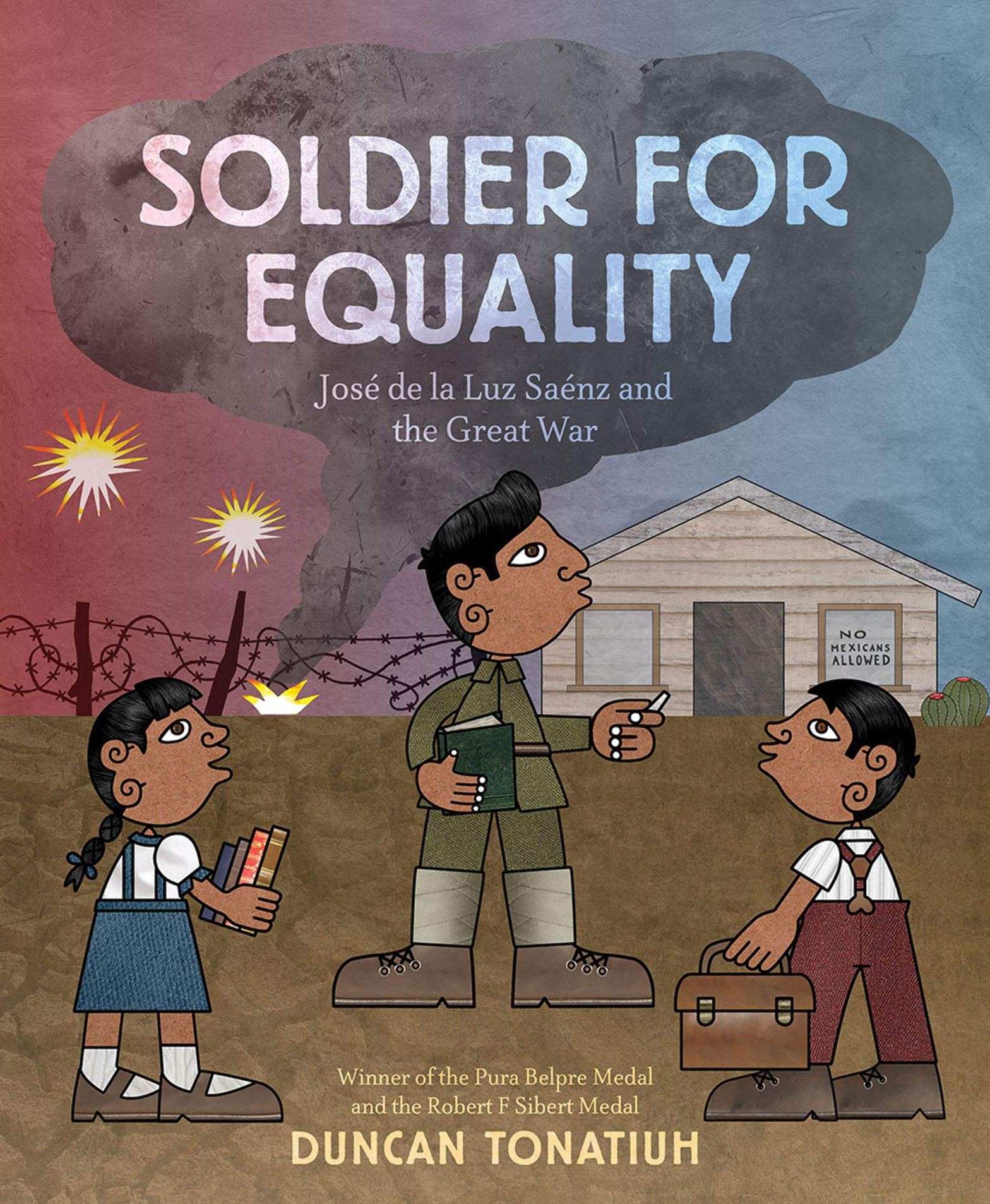
Tonatiuh, Duncan. 2019. Soldiers for Equality: José de la Luz Sáenz and the Great War. New York: Abrams Books for Young Readers. ISBN: 978-1419736827. Hoopladigital.com
PLOT SUMMARY
U.S. born José de la Luz Sáenz is destined for civil rights. He is aware of the discrimination against Mexican Americans from an early age, and he responds by fighting his aggressors back. After graduating high school, he becomes a teacher, teaching children during the day in a segregated school, and adult literacy at night. Luz is bothered by the inferior treatment Mexicans receive in education and the community.
He answers the call to serve in the army not only to demonstrate his patriotism, but believing that white Americans will finally treat Mexicans equally for serving alongside them in the First World War. While stationed in Europe, his scholarly predispositions allow him to stay out of combat as he serves as a French-to-English translator in the intelligence office. While he appreciates that books have kept him safe 30-feet underground, he resents that he is not given credit for his work, and is never promoted in rank. He realizes Mexican soldiers are still being discriminated despite their service, and is even being called a “greaser” while training in Camp Travis. Luz is mindful of his initial reason for becoming a solider throughout his service, however. Before sailing back home, he gathers and informs soldiers of his intention to form a union to fight for equality and veteran rights at home.
When the 360th regiment arrives in San Antonio a year and four months later, despite the festive welcome, it is as if time has stood still in Texas. Signs are still banning Mexicans from businesses and the schools are still in poor condition. With diplomatic resolve, he and other civil rights leaders establish The League of United Latin American Citizens (LULAC) in 1929, the oldest Latino civil rights group in the United States. LULAC triumphed in integrating Mexican Americans and Latinos into all-white schools in Texas and continues to represent Latinx civil rights to this day.
CRITICAL ANALYSIS
Tonatiuh sheds light at an individual that contributed to the Chicano struggle before Cesar Chavez was even born, and whose legacy remains with the ongoing civil rights organization LULAC.
A Mexican American growing up in Texas at the turn of the 20th century, Luz spends a lifetime challenging a racist society. Bullied simply for being Mexican since he is a child, despite being American-born, Luz grows up hyperaware of his lineage and culture. By the second spread, Tonatiuh sets the times without having to digress from Luz’s biography by including storefronts signs that read “No Dogs or Mexicans” and “Whites Only” (10-11). Luz does not deny his heritage in big part because he knows that Mexicans are hard-working respectable people. He recognizes that racism is putting his neighborhood at a disadvantage, especially when it comes to education.
As opposed to many Latinx characters, who are blue collar laborers, Luz is a scholar. Many Mexican males in 1905 did not graduate from high school, having to help the family in the fields, or having immigrated from Mexico specifically to work. Luz is a good student and a born teacher. He teaches adult literacy both in Texas and abroad, and teaches himself French. Luz’s is the only written account from a Mexican soldier from the First World War (44). The same farsightedness that allows him to envision an integrated Texas inspired him to keep written records of his service for posterity. The activist and diplomat in him mandate he keep records to use as proof and in defense in court. Luz is too smart to simply accept that discrimination is a part of life. He knows education and organization are needed to enact change.
He serves his country on the condition that his country will treat him with the dignity and respect war veterans deserve. He uses his time in service efficiently, making connections with fellow Mexican soldiers and making a pact that he will represent their rights in the United States.
Soldier for Equality carries the political and social record of Texas. First colonized by Spain, then belonging to Mexico until its independence in 1836 (Neu, 1994), Mexicans and those of Spanish descent have old roots in the state. The annexation of Texas into the Union in 1845 launched the Mexican-American War and the loss of Mexican territory to the United States (Editors). The anti-Mexican and anti-Gringo sentiments have had decades to brew. It is ironic that Luz should face discrimination in the city of San Antonio, which is predominantly Mexican and was established by the Spanish (Jasinski, 2021). Always ironic in minority war narratives is when they are themselves oppressed while fighting for democracy in the name of the United States elsewhere in the world.
Tonatiuh’s iconic illustrations are especially emblematic in Soldier for Equality. To have this part of European history represented in pre-Colombian inspired artwork is a sight to behold. Representative of the mix of cultures that make up the country, U.S. soldiers in training and in trenches are shown in profile, with different shades of skin and hair color. The spread of the Mexican children in Luz’s classroom is particularly stunning. All of them are the same shade of brown, their hair a lustrous black. However, each has a different hairstyle, facial characteristic, or expression so that, although they are uniform and unified, they do not lose their individuality.
Solider for Equality widens the repertoire of children’s biographies on Latinx individuals. It educates Latinx children on Luz’s contributions whilst making them aware of an active civil rights organization, in case they ever need representation. For non-Latinx children, it offers an alternative narrative to the one always taught in history books. Luz led a life of intent, taking advantage of every opportunity to get to his end goal. Since many Latinx children will start off disadvantaged, Luz’s story serves as inspiration to be proud, be bold, and be devoted in reaching their objectives.
References
Editors of Encyclopaedia Britannica. “Mexican-American War: Mexico-United States [1846-1848]. Britannica. https://www.britannica.com/event/Mexican-American-War
Jasinski, Laurie E. 2021. “San Antonio, TX.” Texas State Historical Association Handbook of Texas, January 27, 2021.https://www.tshaonline.org/handbook/entries/san-antonio-tx
Neu, C.T. 1994. “Annexation.” Texas State Historical Association Handbook of Texas, November 1, 1994. https://www.tshaonline.org/handbook/entries/annexation
AWARDS
2020 Americas Award for Children’s and Young Adult Literature, Commended Title
2020 Orbis Pictus Award for Outstanding Nonfiction for Children, Honor, Non Fiction
2020 Pura Belpre Award, Honor, Author
2019 Northern Dawn Book Awards, Winner, Historical
REVIEW EXCERPTS
From Booklist, starred review: “Using kid-friendly language that doesn’t shy away from the ugliness of prejudice and war, Tonatiuh expertly crafts an informative and engaging picture book biography supported by primary sources. If the straightforward text doesn’t grab young readers, the arresting pre-Columbian inspired art will.”
From Kirkus Reviews, starred review: “The author’s insightful use of Sáenz’s war-diary entries boldly introduces this extraordinary American’s triumphs and struggles . . . An important contribution to this volatile chapter in U.S. and Mexican American history.”
From Publishers Weekly: “An inspiring introduction to an underrepresented figure who pursued his lifelong vision for equality and justice.”
CONNECTIONS
Regarding school segregation, Tonatiuh’s Separate is Never Equal is a must-read companion to Soldier for Equality. ISBN: 978-1419710544.
Above children’s reading level, this title gives an alternative, more inclusive, view of San Antonio and Texas history for parents, teachers, and librarians to consider:
-Burrough, Bryan, et al. Forget the Alamo: The Rise and Fall of an American Myth. 2021. ISBN: 978-1984880093.

 Biblioterika