BIBLIOGRAPHY
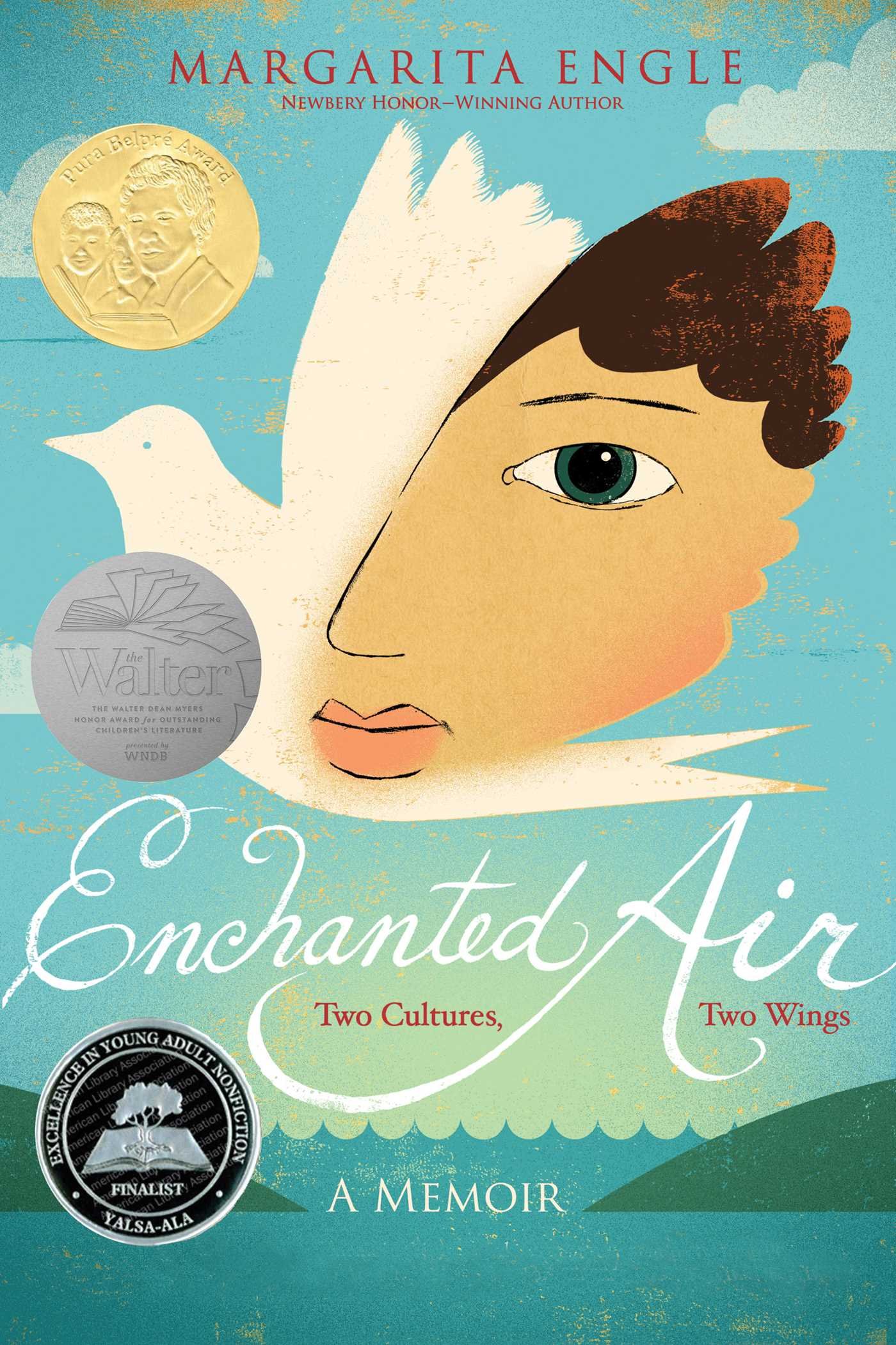
Engle, Margarita. 2015. Enchanted Air: Two Cultures, Two Wings: A Memoir. New York: Atheneum Books for Young Readers. ISBN: 978-1481435222.
PLOT SUMMARY
Margarita Engle’s memoir consists of five sections. The brief “Love at First Sight” section tells how Engle’s parents meet and how her mother left Cuba for her father. In “Magical Travels (1951-1959),” Engle establishes that she feels more comfortable in Cuba, despite being American and fractions of Cuban, Ukrainian, and Jewish. She is a bookish, withdrawn loner in California, where she feels she is different for speaking Spanish and knowing what a palm tree looks like in the wind, unlike her Anglo teacher and classmates. In “Winged Summer (1960)” Engle details memories of the last full summer she spends in Cuba. She is brave, wild, and free, that summer, despite Cuba still fighting a quiet civil war. The angst of adolescent is magnified by the ever-present anxiety of the Cold War in the “Strange Sky (1961-1964)” years. The year of “Two Wings (1965),” Engle and her family finally find some respite from political tension and discrimination in their travels to Europe.
CRITICAL ANALYSIS
Enchanted Air adds the third side to the Cuban Missile Crisis story, or rather, the fleeting paragraph on the subject often dedicated to the island in U.S. History books. As Engle observes in her “Invisible” poem, after political ties were broken with Cuba, Americans hardly know anything else about the island except that it is Communist. With diplomatic relations reassuming between the two countries under the Obama administration in 2015 American citizens have been able to finally travel to Cuba (Engle, 188-89). However, the Cuban-American experience has not been accurately represented for more than fifty years in American Literature.
Engle’s narrative conveys the somnambulism that marks political exile. Her narrative is definitely a José Martí white rose—placing human experience above political divisiveness. When Cuba is synonymous with Communism, however, it is hard to ignore the politics. Engle knows history has been biased and told from the perspective of world powers. Cuba is cornered by both the Soviet Union and the U.S., Engle claims in “Three Sides to Every Story” (147). When “tiny Cuba wins,” (131) during the Bay of Pigs invasion, and then dares to hide Soviet Union missiles, the U.S. chooses to minimize its political power and role in the Cold War. Engle breaks the silence and empathically relates the trauma many Cuban refugees experienced as stateless “ghosts.” The countries may have been able to break relations overnight, but refugees and Cuban citizens like Engle’s mother could not suddenly stop being Cuban or carrying the island in their being.
American born, but part Cuban, Ukrainian and Jewish, Engle is definitely a mix of cultures. Engle is first generation American born in her mother’s side, and second generation on her father’s side. Engle’s paternal grandparents escaped Ukraine and still speak Russian and Yiddish which means they are not fully assimilated. Despite her mix, however, Engle’s heart lies with Cuba. She longs to be her brave “invisible twin” full time in the United States as well.
We get the introspective, “wistful” (21) Margarita in Enchanted Air. We know her sister Magdalena as Mad, her mother as Mami and her father as Dad. Except for the time she is called gordita by a relative and the few times she alludes to her lack of athleticism… Engle is very reserved about how others view her, physically or emotionally. She never once addresses herself with a nickname, or even by name, in her memoir. Engle seems afraid of forging friendships or relationships outside of her family. She runs from her first kiss and has only books as friends for the first 14 years of her life. The few acquaintances she makes are bad influences, which being so bookish, at eleven, she’s wise enough to know that is not her path to take.
Year 1960 is a coming of age for Engle. The “Winged Summer” section makes permanent Engle’s ephemeral memories, but also relates what makes a person Cuban. Walking on war threaded and perhaps even burial ground; playing death as an instrument; riding a horse without proper equipment. These are things Engle’s suburban-raised Anglo classmates could not even imagine, much less endure. Most heartbreaking is the shattered plans of raising her colt “next summer.” A summer that took decades to arrive. How many colts were born and died in the time Engle was unable to visit Cuba? Engles says she was able to visit Cuba before it was open to Americans, but how many others did not have the means to secure a pass? How many of their relatives died without them being able to keep vigil at their bedside?
Engle’s memoir is proof that no matter our background, some places and cultures speak to us. Centering her poems in travel and flight, Engle celebrates her “two cultures” and “two wings,” instead of feeling cursed by their dichotomy. As a poet, she uses and dissects the English and Spanish language, appreciative of what each one allows her to communicate, dream, and create. Her memoir and author’s note reflect the growing opinion amongst immigrant communities and interracial individuals that cultures are meant to be embraced and nurtured, or else we feel as if a piece of us is missing. Being part of two or more cultures need not be like a fairy tale, or a Cold War, where the good must triumph over evil, but rather affords a more diplomatic worldview, to be able to appreciate and embrace the differences that divide us.
AWARDS
2016 Pura Belpré Award Winner
2016 Americas Award for Children’s and Young Adult Literature, Commended Title
2016 Skipping Stones Honor Award, Winner, Multicultural And International
2016 YALSA Excellence in Young Adult Nonfiction, Finalist
2016 The Walter Dean Myers Honor Award for Outstanding Children’s Literature, Honor Book
REVIEW EXCERPTS
From School Library Journal, starred review: “A deeply personal memoir-in-verse filled with Engle’s trademark intricately woven lyricism.”
From Kirkus Reviews, starred review: “Though it is a very personal story, it is also one that touches on issues affecting so many immigrants…. As so many of our children are immigrants or children of immigrants, we need more of these stories, especially when they are as beautifully told as this one.”
From Booklist, starred review: “The book’s poignancy and layered beauty make it a worthy addition to any collection and a fitting companion to Jacqueline Woodson’s Brown Girl Dreaming (2014) and Thanhha Lai’s Inside Out and Back Again (2011).”
CONNECTIONS
Engle, Margarita. 2019. Soaring Earth: A companion Memoir to Enchanted Air. Engle narrates her adolescence in midst of nation and worldwide unrest. ISBN: 978-1534429536
A classic, Julia Alvarez’ In the Time of the Butterfliesfocuses on the murder of three women under the Trujillo dictatorship in the Dominican Republic, spanning the same timeline.

 Biblioterika