BIBLIOGRAPHY
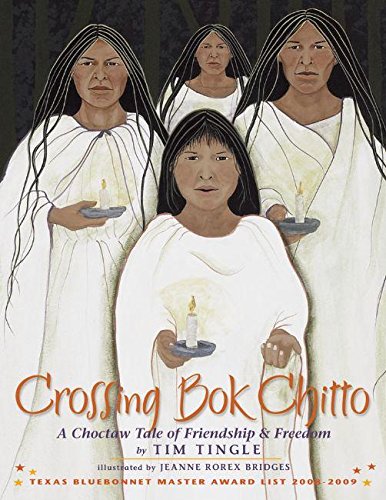
Tingle, Tim. 2006. Illustrated by Jeanne Rorex Bridges. Crossing Bok Chitto: a Choctaw Tale of Friendship & Freedom. El Paso: Cinco Punto Press. ISBN: 978-0938317777.
PLOT SUMMARY
Not finding any blackberries on her side for a Choctaw wedding ceremony, Martha Tom forbiddingly crosses the Bok Chitto river using the hidden rock path. Across the banks is a plantation supported by slave hands. As she finally finds a patch and begins picking the fruit, she witnesses a preacher give a call for slave church service. She stands entranced by the congregation’s hymns when a man notices her, and instructs his son, Little Mo, to help her home before there is any trouble. After this, Martha makes a habit of crossing the river and attending the services many Sundays with Little Mo’s family. Little Mo crosses over to the Choctaw village as well.
Tragedy strikes one day: the slaveholder has sold Little Mo’s mother to a new owner in New Orleans. To keep from being separated forever, Little Mo, his parents, and three siblings decide to run away and cross Bok Chitto to the Choctaw village, which will set them free. With supernatural resolve the family manages to walk out their hut’s front door, past guard and dogs. Little Mo, whose full name is Moses, finds the hidden rocks despite his fear and runs to ask Martha Tom for help crossing his family. Martha Tom’s mother and the women of the village dress in the traditional white gowns they wore for the wedding, holding candles to light the way, this time for a crossing ceremony. It appears as if angels are welcoming seven Black spirits into the afterlife as they help Little Mo’s family walk on water across the river, and so the armed guards are too awestruck to fire at the escaping family. They are together, and free.
CRITICAL ANALYSIS
The careful research taken to create Crossing Bok Chitto deems it an authentic Native American narrative which holds literary merit and cultural relevance even 15 years after publication. Tim Tingle, a member of the Choctaw Nation, admits in his author’s note that Crossing Bok Chitto is a work of fiction based on true events inspired by his visit to the Choctaw Nation in Mississippi. Illustrator Jeanne Rorex Bridges, of Cherokee descent, focused her art on “depicting the shared history of Southeastern Indians and African Americans” (biography) before Martha and Mo’s story was ever published.
Given the timeline as the early 1800s “before the War Between the States…before the Trail of Tears,” both Choctaws and African Americans are depicted accurately in physical characteristics and circumstance. Rorex Bridges paints her characters’ features with an elegantly and humanistic brush. Painted in portrait mode, characters make eye-contact with the readers, somtimes behind tears. The realistic artwork paired with their firm gazes bring the characters to life. It is interesting how the only characters never making eye contact are the white plantation owners and guards: They assume second character roles often assigned to BIPOC in literature.
Despite the timeframe and traditional setting, Rorex Bridges hints at the intermixing of races. Martha Tom, her mother and female neighbors are different shades of red-brown with blushed cheeks, wide noses and not all have distinctive jawlines. All have the long, black, or salt-and-pepper hair. In the two spreads where they are portrayed, the Choctaw men also have long dark hair and one wears it in two braids. African Americans have rich dark skin. Most of African Americans portrayed have dark eyes, wide noses, full lips and tightly coiled hair. Although Little Mo’s family all share the same pigment, when portraying the church crowd there are varying skin shades.
Except for the Choctaw ceremonial gowns and moccasins, all three groups dress with modern 19th century clothing. Native and African Americans wear simpler attire than their whiter counterparts. Although none of their clothes are portrayed as dirty or ragged, the spread where Little Mo crosses Bok Chitto shows his bare feet and tattered best Sunday trousers. The Black women wear head scarves or pixie-short hair, reflective of a life overburdened by work.
of note is that the book not once features an indoor scene. The Choctaw’s homes and slave huts are portrayed from the outside. The landscapes are afforded as much attention and characteristics as the portraits. Readers get a feel for the rolling plains, protective woods, and flowing waters.
Characters’ personality is established in the narrative. Martha Tom’s mother asserts authority with her daughter and in the community. She gives Moses orders on how to keep his family safe from guard detection and immediately wakes up and urges the other Choctaw women to organize for the ceremonial crossing. Martha Tom knows her mother has a soft heart and is why she disobeys and crosses the river in the first place. She is a child confident enough in nature to wander into dangerous territory. Little Mo’s family personifies the brotherhood that existed between Native and African Americans. Little Mo’s father does not mistreat Martha Tom for being Indian upon meeting her. Rather, the whole congregation accept and welcome her presence during sermons on Sundays. Despite Little Mo’s father defying plantation owners to attend illegal slave religious services, the relentless realities of slavery drive him to simply accept his fate of losing his wife. Little Mo, however, has tasted freedom crossing Bok Chitto repeatedly with Martha Tom after church services. He is aware of the Choctaw lifestyle, and the freedom it ensures. This knowledge allow him to convice his defeated family to risk capture instead of surrendering to their fate.
Crossing Bok Chitto reminds us of a history forgotten, even ignored. The book speaks to the resilience and alliance between oppressed people, but also urges readers to use their position, influence, and strenghts to help others come out from places of oppression.
AWARDS
2008 American Indian Youth Services Literature Picture Book Award Winner
2008 Texas Bluebonnet Master Award List
REVIEW EXCERPTS
From Booklist: “In a picture book that highlights rarely discussed intersections between Native Americans in the South and African Americans in bondage, a noted Choctaw storyteller and Cherokee artist join forces with stirring results.”
From Midwestern Book Review: “Crossing Bok Chitto is very highly recommended for all young readers as a celebration of diversity, acceptance, and unity in a remarkable production of expert authorship and invaluable illustrations.”
From World Of Words (University of Arizona): “Attending Bacone College in Muskogee, Oklahoma, Bridges took classes in Indian art and learned the flat style of painting which originated by the Kiowa Five…. Flat style fits the historical and folkloric plot and setting of this story. Bridges uses acrylics on watercolor board paintings to create bold, mural-like illustrations that seem like portraits. Strong, emotion-filled, solid figures stare out at the reader.”
CONNECTIONS
Check out Tim Tingle’s autobiographical book Saltypie (2010), which focuses on the leadership role of Choctaw women.
Traci Sorrel: We Are Still Here (2021). Educational text that relates Native American history. Her multiple award-winning We Are Grateful: Otsaliheliga (2018) is a celebratory narrative of Cherokee culture.
Cynthia Leitich Smith: Ancestor Approved: Intertribal Stories for Kids (2021). A chapter book, older readers, 3rd grade and up, will be able to appreciate this collection reading independently.

 Biblioterika