BIBLIOGRAPHY
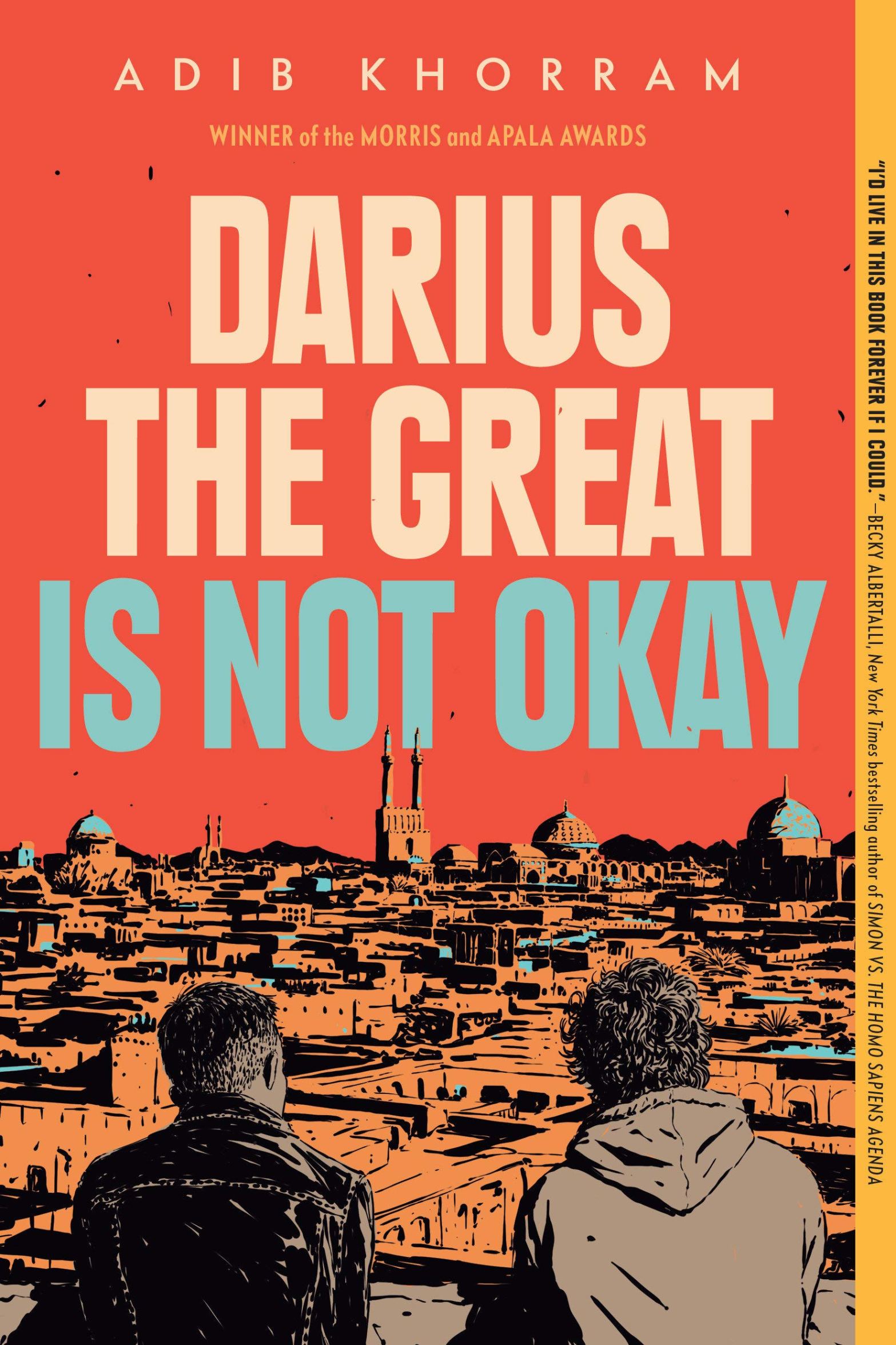
Khorram, Adib. 2018. Darius the Great in Not Okay. New York: Dial Books. ISBN: 978-0525552963. hoopladigital.com
PLOT SUMMARY
A student of Chapel Hill High School in Portland, Darius Kellner is half Iranian (Fractional Persian (32)) and half white, and not full Übermensch (13), as his father Stephen Kellner. A Star Trek nerd, he does not fit in at school and his only acquaintance is another Iranian student, Javaneh Esfahani. His purpose in life seems to be to disappoint his father, with the only thing in common other than Star Trek is that they both take medicine for clinical depression.
After learning Babou’s health is deteriorating due to his brain tumor, Darius’s parents decide to book a trip to Yazd, Iran. Having only spoken to his grandparents over video chat, Darius feels terrible for not feeling worse about his grandfather dying and is apprehensive about meeting them.
The trip to Yazd opens the emotionally blocked up well inside Darius (29, 299), however. Highly expressive and affectionate, Darius falls in love with his Mamou in the ride from the airport to her home in Yazd. It takes a little longer for Babou and Darius to connect, but they do eventually. Aside from learning about ancient Iranian culture and architecture, Darius finds a sense of self through the help of his friend Sohrab. Cheerful, yet isolated from his peers as much as Darius, Sohrab, an only child whose Bahá’í father is imprisoned, is happy to have someone to connect and be carefree. Darius and Sohrab fill each other’s empty places (196).
The climax of the novel comes at the end, when Sohrab’s father is stabbed to death in prison and, in his engulfing grief, Sohrab want to hurt Darius too, for being unhappy with his full life. Sohrab yells that nobody wants Darius there. Already having experienced “slingshot maneuvers”(30) during his stay in Iran, hearing those words from his one and only best friend is heartbreaking for Darius. His father eventually finds Darius hiding out in his and Sohrab’s favorite hangout spot, and Stephen Kellner expresses his true feelings regarding depression and his relationship to Darius. This conversation marks a shift in their father-son relationship, for the better. Sohrab apologizes to Darius and they keep in touch through email once the family flies back to Portland.
Having been Darioush, Darius returns to Chapel Hill High School with newfound confidence. He decides to try out for the Charger’s soccer team and begins to feel great for the first time in his life.
CRITICAL ANALYSIS
Darius has a distinct, humorous voice. Throughout the novel he creates unique phrases— often associated with Star Trek—to describe his life, his culture, his feelings. In his book, bullies are “Soulless Minions of Orthodoxy” (4), he is a “Fractional Persian” vs a “True Persian” (32), soccer becomes “Non-American football” (101), and mood swings are “slingshot maneuvers” (30). He refers to all adults using their full names and to his father specifically as a “Teutonic Übermensch” (19). Darius is obsessed with tea and how to brew it flawlessly, and in that respect, he is Elitist Persian. Despite being about Persian culture, Darius the Great is Not Okay deals with universal topics of gaining confidence and independence in adolescence. Prior to visiting Iran, Darius struggles with his identity, self-worth, and relation to his Teutonic masculine father.
Portland is a different world than Yazd. Yet, despite never have stepped foot in Iran or speaking Farsi fluently, Darius knows more than the basics of Persian culture. His parents are members of the tightknit Iranian community in Portland. The Kellners observe Nowruz (the Iranian New Year’s Day) and Stephen Kellner is a fan of fire jumping during Chaharshanbeh Suri, celebrated the Tuesday before Nowruz (32). His mother partakes in the export/import transactions that arise when the neighbors realize there will be an Iranian going back to the home country. The Kellners consistently eat authentic Persian food, thus the reason why Darius’s Farsi food vocabulary surpasses any other subject matter. Prior to landing in Tehran, Stephen and Darius have already experienced multiple times feeling left out when everyone else is speaking Farsi or confusion at following the social cues of tarrof or “Persian Casual” (169). Khorram’s narrative definitely offers a touristic view of Iran, but readers still appreciate the culture and understand Darius’s growth because of the experience. Darius oftentimes interjects with cultural explanations that deem him an insider of Persian culture, despite being only a Fractional Persian.
Khorram does not offer political commentary, but subtly, the politics of Iran make their way into Khorram’s narrative. Darius is jokingly called a terrorist at school and rumored to have joined ISIS during his trip to Iran. Because outsiders only get a protected tourist view of Yazd, Sohrab’s father’s arrest, prison isolation, and death comes as a shock. However, upon closer inspection the hints that members of the Bahá’í religion are highly persecuted by the Iranian government are laid out in the novel. Sohrab argues that “the government doesn’t like Bahá’ís” (194) and that Zoroastrians (Darius’s Persian family’s religion) have it easier in the Muslim state. Sohrab mentions how his soccer rival Ali-Reza is “very prejudiced against Bahá’ís” (110), and readers wonder if that has marginalized Sohrab and is the reason why Darius, an outsider, is his first best friend. Sohrab’s father’s death incites readers to do their own research pertaining to the political state of Iran. Khorram does not paint Muslims as evil. Twice he mentions how beautiful the azan, or call to prayer, sounds and the mystical feeling created when people form “a titanic multicellular entity focused on the same moment in space-time” (281). Through these descriptions Khorram implies that not all Iranians are Muslim and that not all Muslims are extremists, but there are definite human rights violations in the religious state.
Aside from the struggle of being a Fractional Persian, Darius also brings up definitions of masculinity. There are multiple phallic scenes throughout the novel. The novel opens with Trent Bolger dishing out sexually suggestive insults at Darius, followed with the “truck nuts” (10) incident. Darius knows his overweight body is not Teutonic like his father’s but he is familiar and not 100% ashamed of it. He masturbates at home and comfortably lies naked in his bedroom at his grandmother’s house, although he knows he will never go “number three” there. After playing soccer with Sohrab, Ali Reza, and Hossein, in the locker room, they give Darius a Persian nickname based solely on the look of his uncircumcised penis. Although self-consciously, he still wears his tight soccer jersey during all subsequent soccer matches after receiving it. There are hints of Darius’s homosexuality in his interactions with Sohrab. Boys and men touching nonchalantly may be common in Iran, but it triggers goosebumps in Darius. Perhaps the biggest hint is when Darius is so heartbroken at being rejected by Sohrab he cries atop their rooftop for hours and his father searches his face for an answer. Khorram’s narrative however, leaves open the idea that boys and men can maintain close, heartfelt relationships without necessarily being outright gay, which is a novel idea in our society.
Listening to the audiobook heightens the cultural experience through hearing proper Farsi pronunciations and Iranian English accents. Michael Levi Harris’s reading brings forth the character of the novel, with his impression of Stephen Kellner being particularly stellar.
Darius the Great is Not Okay takes readers on a cultural and emotional awakening. Funny without being cynical, Khorram brings a fresh and engaging voice to shine light upon major depressive disorder, and what it is to live with this mental illness. Readers will love exploring Yazd and will be happy that Darius finds connection with his past, as well as resolve to shape his future.
AWARDS
2019 Asian Pacific American Award for Literature, Winner, Young Adult
2019 Amelia Elizabeth Walden Award, Finalist, Young Adult Literature
2019 Boston Globe-Horn Book Award for Excellence in Children’s Literature, Honor Book, Fiction and Poetry
2019 Friends of American Writers Young People’s Literature Award, Winner
2019 Indies Choice Book Award, Honor, Young Adult Book
2019 Lambda Literary Award, Finalist, LGBT Children’s/Young Adult
2019 Middle East Book Award, Winner, Youth Literature
2019 William C. Morris Award, Winner
2019 Young People’s Literature Award, Winner, Young People’s Literature
2018 Cybils Awards, Finalist, Young Adult Fiction
REVIEW EXCERPTS
From AudioFile: “[Narrator Michael Levi] Harris brings out all of Sohrab’s earnest sweetness, and his sensitive narration emphasizes the connection between the boys as well as Darius’s yearning to recapture the relationship he had with his father when he was younger.”
From Booklist: “Darius is a keen observer of life and very much aware of his emotional mechanisms…But most significant is his friendship with Sohrab, which is tinged with an intimacy that suggests it is something more than platonic. This is a refreshing bildungsroman and an admirable debut novel that will leave readers wanting more.”
From CCBC: “Darius is a funny and tender first-person narrator in a debut novel with terrifically drawn characters, richly depicted relationships, and full of warmth and hope.”
CONNECTIONS
Read the sequel, Darius the Great Deserves Better. 2020. Darius is openly gay and has more agency in his life despite his clinical depression, but he realizes doing okay does not necessarily mean decisions cannot be made to feel even better.
Ribay, Randy. 2020. Patron Saints of Nothing. Although Khorram does not go into too much detail about the political tension in Iran, it affects Shorab heartbreakingly. Ribay focuses on the drug war in the Philippines and how his protagonist, an Americanized Filipino, reacts to the political crimes in his family and motherland.
Philippe, Ben. 2020. The Field Guide to the North American Teenager. Black French Canadian Norris Kaplan moves to Austin and is forced to attend an American High School. Despite what he thinks he knows about being an American teenager, there may be more to people than the stereotypes with which he has classified them in his mind.
Check out Aristotle and Dante Discover the Secrets of the Universe by Benjamin Alire Sáenz and the accompaying connections.

 Biblioterika