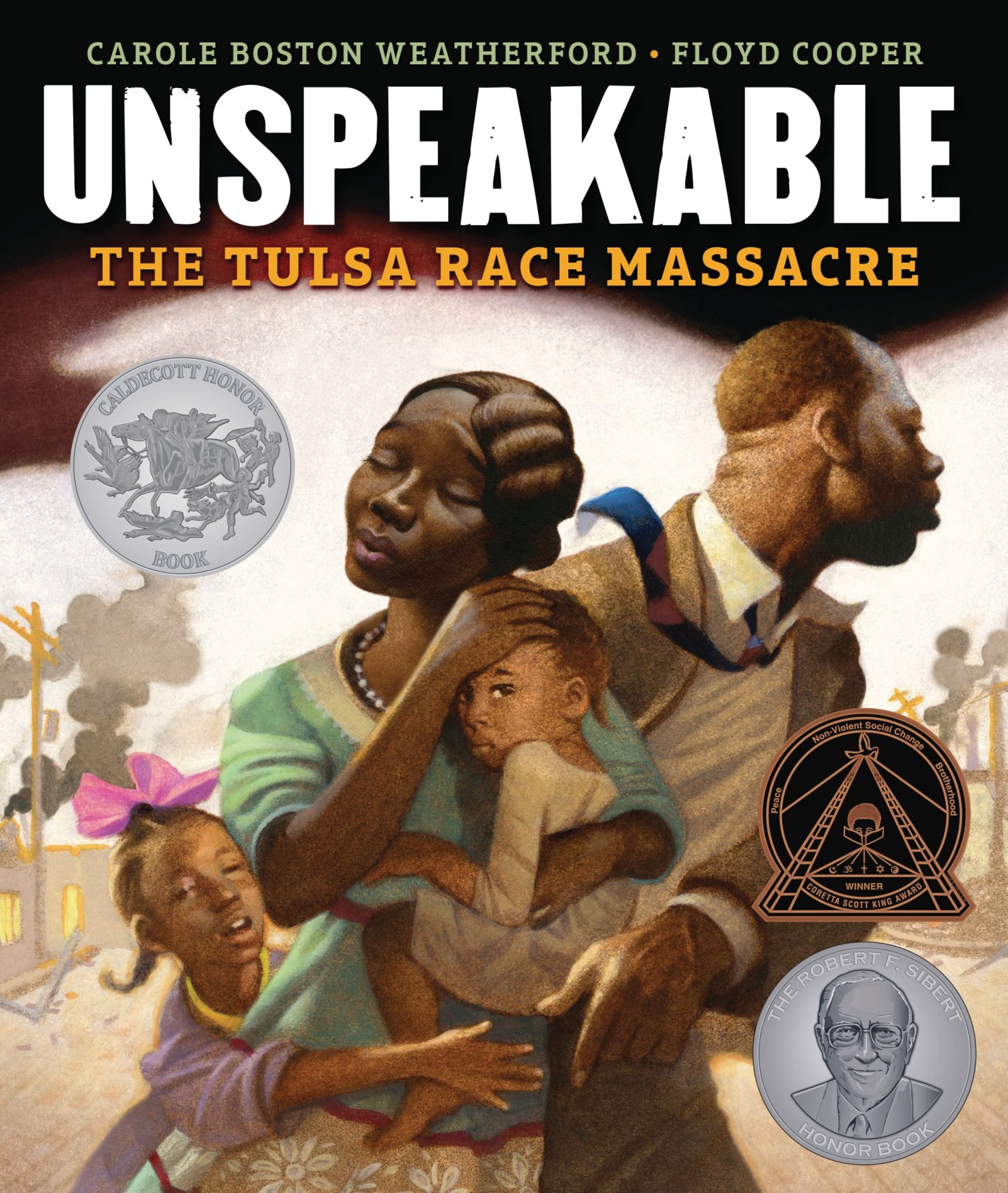
Written by Carole Boston Weatherford, illustrated by Floyd Cooper

A Coretta Scott King Award Winner for author and illustrator, a Caldecott Honor Book, a Robert E. Sibert Honor Book, and a Texas Bluebonnet Reading List Title, Unspeakable relates a story that has been buried in time and politics. Both touched personally by the Greenwood massacre, Weatherford and Cooper delved into the work of this book in 2018. After the police brutality protests of 2020 however, the book’s relevance becomes even more prominent.
Summary
Unspeakable uncovers the ignored history of the 1921 Tulsa Race Massacre, where an armed mob of more than 2,000 whites destroyed the affluent all-Black city of Greenwood (population of about 10,000). Half of the book commemorates the prosperity and wealth of Greenwood. Black Wall Street covered the stretch of Greenwood Avenue. Black doctors, lawyers, and businessmen lived on “grand homes” on Detroit Avenue. There was a hospital, libraries, good schools, the Stradford Hotel, and two movie theaters. Remembrance of the Golden Age of Greenwood culminates with “there were even six privately owned airplanes.”
The book’s narration turns dark along with the illustrations with an all-black page and the shoeshine young man, Dick Rowland, going into the white-lit elevator where 17-year-old white elevator operator Sarah Page scowls at him. A lie sets off the demise of this wealthy community. Readers are left to consider: If this happened to affluent Black Americans, what befell those in poorer neighborhood? If the wealthiest Blacks could not restore Greenwood to its pre-depression era prosperity, how could the rest of segregated communities stand a chance? What could have become of this community if not devastated by racism?
Analysis
Despite the emotionally charged events, the book maintains an objective tone. I found it particularly striking that Weatherford chooses to begin this non-fiction account with “once upon a time.” He repeats this fairy tale phrase often throughout the story. As readers we can interpret as him saying: “People will tell you this really did not happen, that is not true.” Because of its destruction, Greenwood falls under the: “Once upon a time this place existed in a time far, far away.” But I also interpreted as: “Greenwood was as perfect and thriving community as Blacks were allowed to have.” It was their fairy tale town, brought down by the villainy and ignorance of racism. There is definitely sadness hidden in that phrase, in the fact that in real life, many fairy tales can end in tragedy.
Both Weatherford and Cooper give their testament in the backmatter, and mention how “survivors did not speak of the terror.” So buried by mainstream media was the event, so used to being silenced and treated as second class citizens, that they did not speak in outrage… but also, reliving the humiliation was likely too much for survivors to bear.
Cooper’s illustrations are realistic without being graphic. The dark skin tones and facial characteristics mindfully drawn. It’s interesting to note that the mob of white attackers is not illustrated at all, the focus being on the Black Greenwood community and what they survived that night. The front and back covers carry most of the emotion of the illustrations. There’s a well-dressed family running from the ruin on the front cover. A distraught, desperate, and praying crowd makes up the back cover, where readers make eye contact with the fearful shocked gaze of a young boy. I think of young Black children reaching for this title and immediately recognizing the fear and perhaps even shame of having Black people portrayed in such vulnerable roles. I know the hope is that we all see their suffering, but given how less emotionally charged the illustrations are on the interior of the book, I think the publishers could have chosen a more dignified cover and saved the vulnerable portrayals for the interior.
The book definitely gives a lot to discuss. The crime was not investigated for 75 years! Aside from the engaging narrative and illustrations, the photographs in the backmatter and especially the devastation of the endpapers elevate the tittle. Unspeakable is not seeking to build division (it’s not saying ALL whites are racist) but rather focuses on holding that faceless mob of whites accountable. This is not only Black history, or Oklahoma history, but American history. As a heterogenous nation we still think in term of “they or them” vs “us or me.” Right, we will not entirely understand the experiences of people of different races from us, but consolidating unspoken, unwritten history and adding it to the mainstream record is definitely a first step to help us come to terms with our history and take steps to change society for the better.
Translation Difficulty
Difficult: It is a lengthy story so translating word for word will be time consuming. Parents can always ask questions in Spanish or have a deeper discussion in Spanish.
Note to Parents
This is definitely a race-charged book. If it was difficult for me to read to my child, I can only imagine a Black or white person reading it to their child. Bluebonnet lists books are recommended for grades 3rd-6th grade, and despite its objective, historical approach, I have to agree that reading Unspeakable to anyone younger may raise more questions than answers for them. Given his response to this and another race-focused book, I can personally say that my five-year old does not yet grasp the concept of race. Aside from giving an account of the violence, the book also mentions killing by lynching. So definitely read first to gage whether your younger children are ready for the content.

 Biblioterika