
¡Hola, hola! Let’s get to it!
I began teaching my son to read Spanish syllables when he was about 4.5 years old in February of 2021. By July of 2021 he was reading words, short sentences, and taking dictation. He completed his 15 hours of summer reading independently and truly earned his library prizes. He is currently reading entire picture and easy reader books in Spanish!
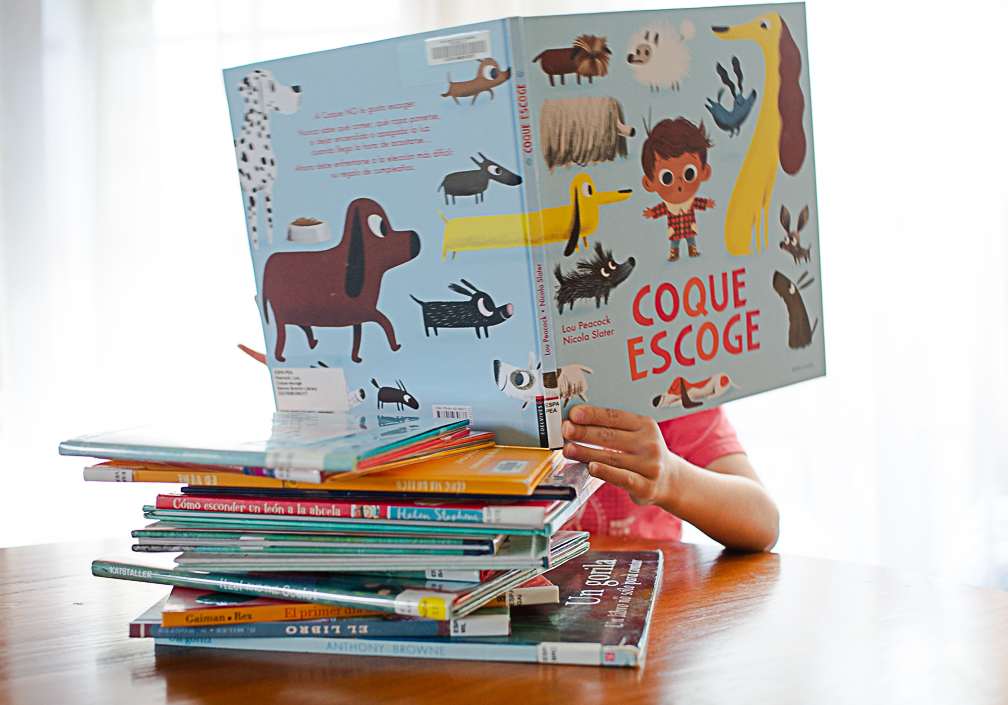
a translation returned to the library without photo session.
Syllables Over Sight Words
I taught Yago to read how I learned to read in México. A friend mentioned that in her district, they focused on sight words in Spanish, focusing on children memorizing high use words instead of teaching based on syllables. Since I was starting from scratch I decided to teach the way I learned. I don’t know how a child can go from identifying después, más, or quién after memorizing the words, to reading words like mariposa, veterinario, or majestuoso simply by sight.
Our Journey
Although Yago had difficulty getting the concept of blending the consonant and vowel sound, it finally clicked a couple of weeks into every day exposure. By April of 2021, only 2 months into his reading journey, he could identify about half the alphabet…

And read two to three syllable words based on the above syllables.

By mid May of 2021 he learned the whole alphabet and could recognize syllables out of order. We are ready to read!
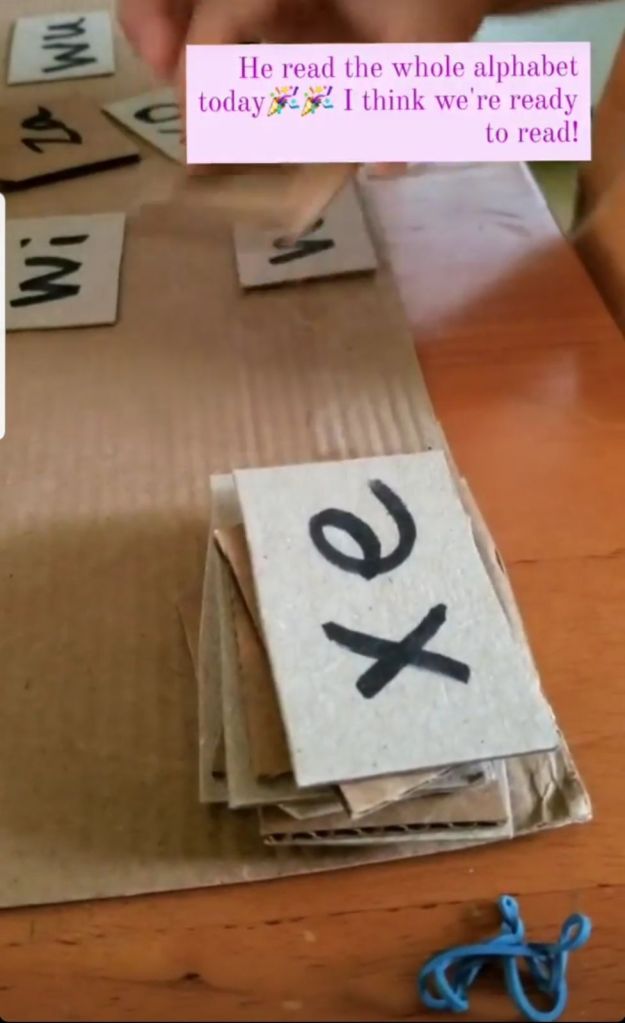
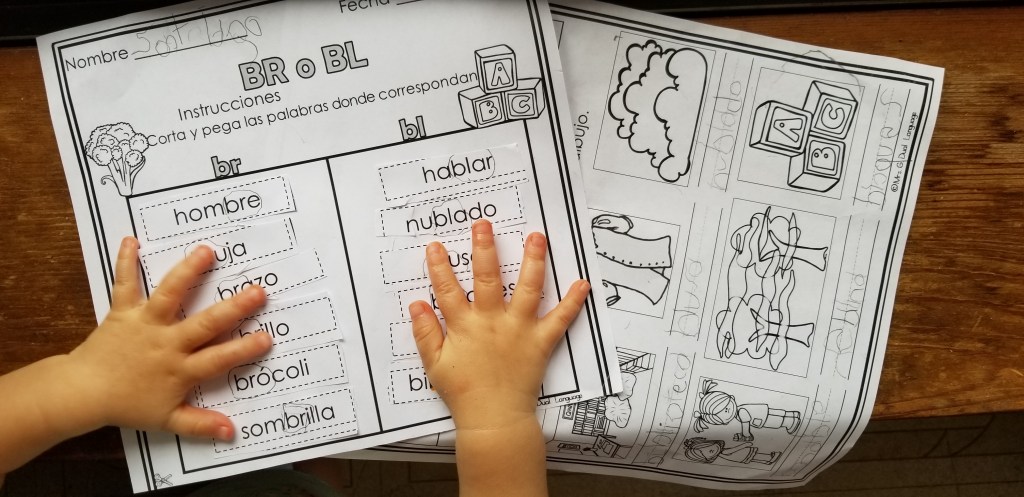
Or so I thought. Silabas trabadas or consonant sound blends like “br” “bl” and even transposed syllables such as “al” instead of “la” really threw him for a loop at first! With practice, he has gotten much better! To help with his learning journey I used teacherspayteachers.com for resources. I searched for worksheets that met the needs he was struggling in, such as blended sounds. I spent only about $40 in worksheets and they helped tremendously!
Below is our latest progress in Spanish reading:
Manos a la obra… Your Turn!
I am linking to a PDF download of a syllables chart I created below. As you saw in the terrible photos above, I actually created manipulatives out of cardboard. I got this idea from a couple of Instagram accounts I follow, mainly @aplayfilledlife. She uses cardboard for a lot of her teaching methods! You can try to buy premade syllable cards online, but customizing to your own size and aesthetic may proof cheaper and more flexible.
STEP 1
A – E – I- O – U -> Vowels First
Before you jump into syllables, make sure your child can identify the vowels by name in Spanish and knows the five vowels sounds. This is particularly important because being proficient in the vowel sounds will make reading syllables a lot faster!
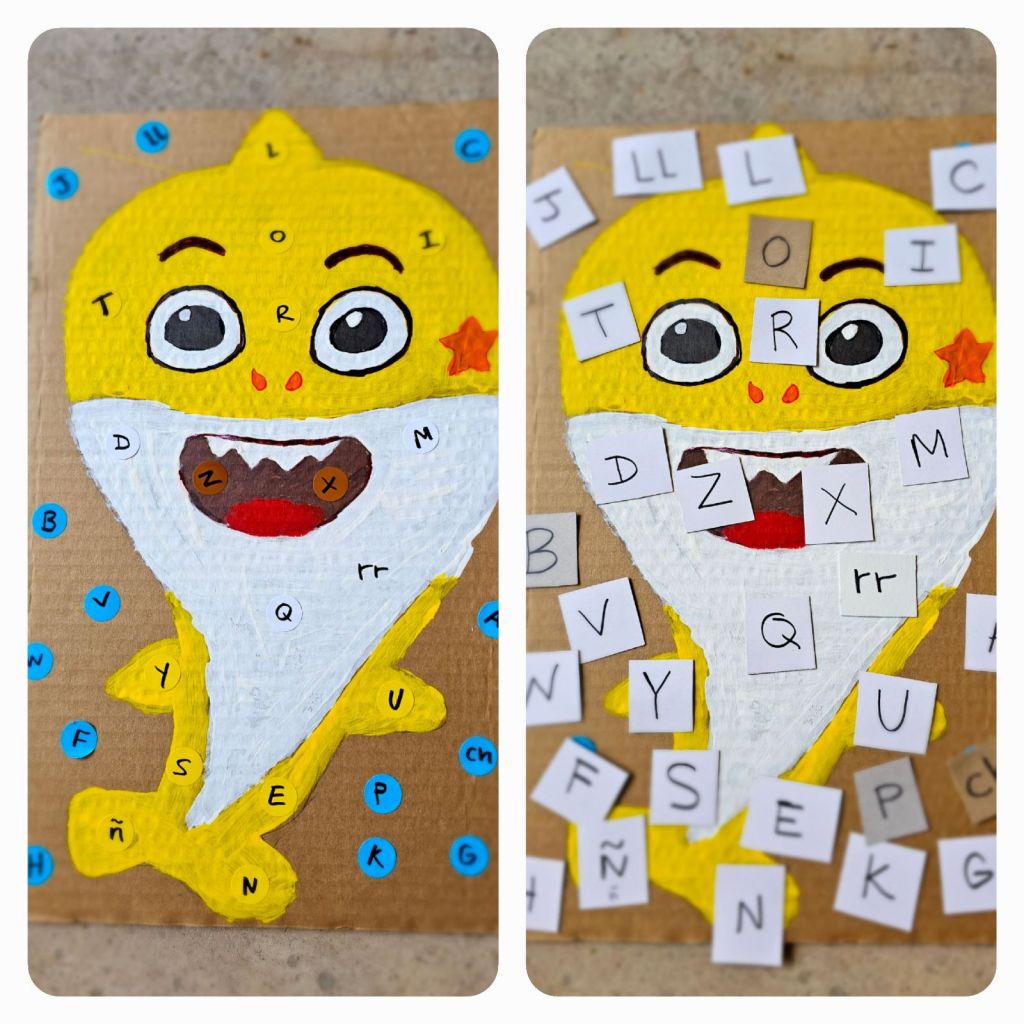
You can make learning vowel and consonant sounds interactive as well. You can trace letters with objects, do salt writing of letters, form letters out of sticks, leaves, or rocks outside. Yago had already been exposed to letters in English through his preschool and his grandfather. I spent a couple of months working on identifying and matching letters in Spanish before we began combining them into syllables.

STEP 2
Create Syllable Template and Cards
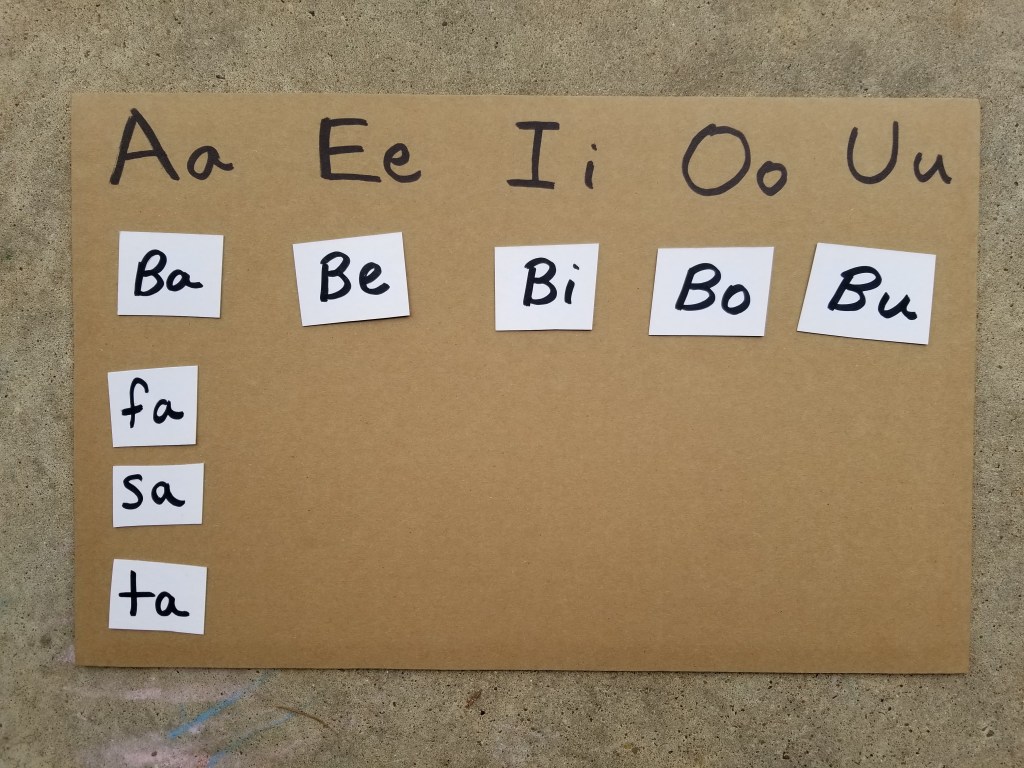
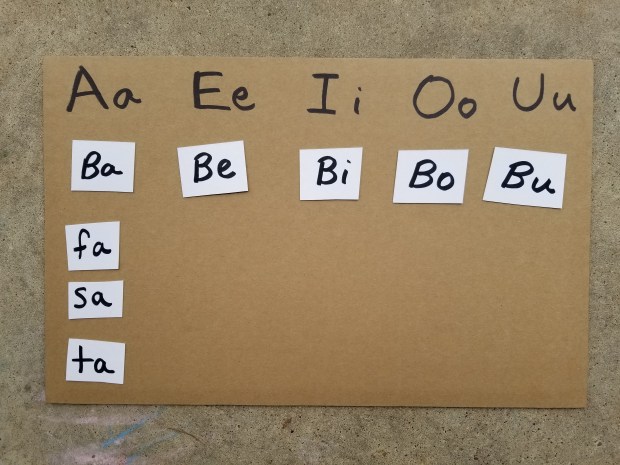
I created the vowel template to be able to align the syllables underneath. Make this one from studier foam or cardboard as you’ll be using it for a while! For the syllable cards, I suggest using cardstock, firm poster board, cereal or snack-box cardboard as they are easier to cut. Make sure each syllable is its own little card. This will allow you more manipulation, like changing the order or arranging into words.
Download the free syllable table I created to guide you. The highlighted syllables have special sounds. I chose to use the lowercase consonants and vowels for most of the syllable cards because that is what they will predominantly encounter in reading. I only used capital B to differentiate from D.
STEP 3
Introduce Consonant Sounds
Once your child is solid in identifying los vocales by name and sound, begin introducing consonants. Since C and G have irregular sounds in Spanish, I waited until the end to introduce those syllables. I went down the alphabet otherwise.
First, I reinforced the sound of the consonant: B. Then, I said: —La B con la A hace BAAAA. La B con la E hace BEEEE–and so on. This is where knowing the vowel sounds truly makes a difference because now they are just connecting sounds. F+A= FA, N+O= NO, etc. After the initial struggle of adding sounds, Yago caught on pretty quickly.
For non-native Spanish speakers, plenty of videos will sound out consonant sounds for you.
I found that having manipulatives for Yago to align under each vowel really drove home the concept. At first we only focused on putting the syllables under the right vowel, and then we sounded them out.
STEP 4
Read Syllables Out of Order
I liked to introduce 3 or 4 consonants at a time, then introduce more once I felt he had mastered that set. For example, D, F, H, and J. Once your child masters reading sets in order, for example fa, fe, fi, fo fu… have them go backwards fu, fo, fi, fe, fa. Or randomly fe, fo, fi, fu, fa. Try lining all the As in the set da, fa, ha, ja, then the E’s, I’s, O’s and U’s. Eventually you can shuffle the cards and they should be able to read: ha, fe, ju, di, jo, fo… etc.

You can then create words from the syllables in each set, as pictured below. Working set by set, in no time, they will be able to read the whole alphabet out of order! This took Yago about 3 months to achieve. We worked on this for sure every weekday for about an hour. Granted, this was during the pandemic as well, so that helped our consistency tremendously.

The goal is not to achieve this in a certain amount of time, risking to frustrate your child. Take it slow and only advance through sets once you feel your child has mastered them. But definitely be consistent in practicing this as daily as possible, or else it is like starting from scratch each time.
For creating words, you can sort them out for your child at first, but eventually, you can say, let’s spell DI-BU-JO (drawing). And have her find the syllables herself.
STEP 5
Continue Practicing Syllables
After Yago could identify syllables out of order, I got overly excited and checked him out a Spanish book to read. Turns out, comprehension slows down reading a whole lot. Since Yago speaks English predominantly, he could read syllables, but, because his vocabulary was lacking, he did not really know the right inflection or how to link the syllables together.
This is where worksheets, booklets, and syllable games come into play. Once they read syllables… children will still need practice putting them together as words. The worksheets I found on teacherspayteachers.com covered the basics from completing two syllable words such as GA-TO (cat), finding two-to-three syllable words in word searches, to practicing more advanced consonant blends or transposed syllables such as “al” “am” “an.”
Another little hiccup in using the syllable method is that some syllables are also one or three letters long, co-mer, a-ba-jo, ár-bol, mag-ni-fi-co, Mau-ri-cio, to name a few. In this case just tell your child that in Spanish, syllables only come with 1, 2, or 3 letters. Usually if a word in Spanish begins with a vowel, this could mean it is a single syllable. If a word is not making sense, have them verify they are pairing the syllables correctly. I’m sure there are worksheets that focus on these type of words but to me, these are “issues” that will arise in reading and resolve with continued practice.
Needless to say, make sure all of this is being read OUT LOUD until you have a proficient reader.
STEP 6
Practice Making and Reading Sentences
Only after you feel like your child is pairing syllables properly and reading independent words proficiently should you try to make sentences. Yago actually took dictation before he was reading books. Writing Spanish (no matter how ugly the handwriting) seems to slow down little ones’ brains to really pay attention to the letters. You can try reading very easy books or worksheets with short sentences to get their confidence up for longer books.

FINALLY, STEP 7
Read Books, And Read Often!
You saw that my method works in the Pinterest reel above. But I still will leave Yago reading an excerpt of Si quieres ver una ballena (2014) a translation originally written by Julie Fogliano and illustrated by Erin E. Stead (If You Want to See a Whale, 2013). This is definitely an advanced title with words such as milimétrico, mordisqueando and ondeando. Explain to me how you can read those from sight! I will have to post an update after Yago finishes his first year in the Dual Language Two-Way classroom.
Updated May 2024. Yago’s latest reading of this page, the improved fluency is tangible after finishing 1st grade in the DL Two way classroom:
Bonus Tips
Do help your children with a title the first time they read it. And if they are really frustrated it is likely too advanced for them. At the library we used to say, if a book has more than five words per page they do not recognize, it is above their reading level.
Choose a time in the day when your child is well-rested and ready for learning! We often did our lessons around 10:00 or 11:00 a.m. Do not go for more than 20 or 30 minutes to begin with. If your child is younger than 4 years, I would say start at 15 minutes.
If your child is in a dual language-two way program already, perhaps a Sunday morning will work best to practice new syllables. After school, I would maybe do 10 minutes before they start their homework and after they have had time to unwind!
Once you are ready, please refer to my post about beginner friendly Spanish reading materials to launch your Spanish speaking journey! Let me know if you have any questions, comments, suggestions, or trouble downloading the PDF.
Happy reading!

updated 5/27/2024

 Biblioterika
4 Comments