
Written by Jesús Trejo, illustrated by Eliza Kinkz
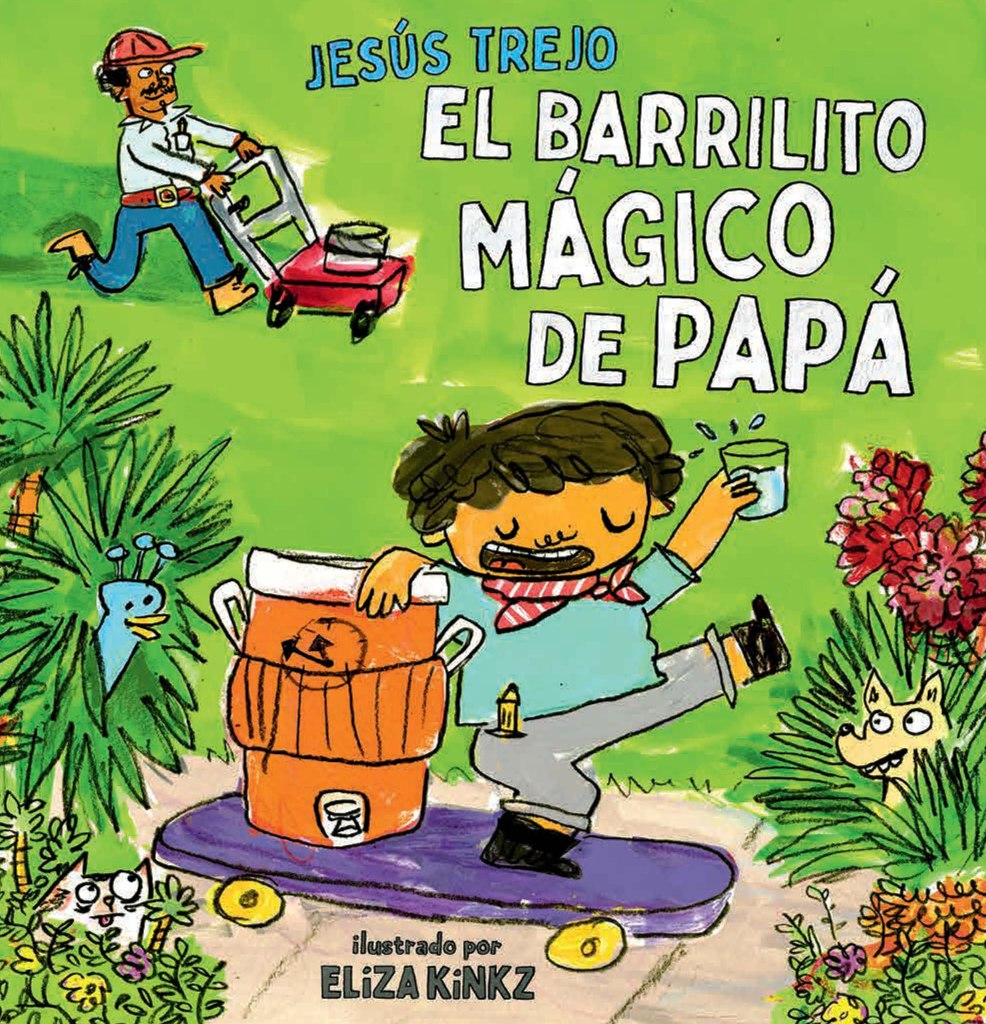
I know, this title is a mouthful and a riddle, especially in English! Water-Jug clock? How in the world? Haha I certainly was confused when I grabbed this from the new titles section of the library but I glanced at the illustrations and I was SOLD!
Before I begin, I have to 100% commend Eliza Kinkz‘s artwork: It is HILARIOUS! If you check out her website you can tell she does not take herself too seriously. She’s a fellow “tejana”, residing in Austin, Texas.
Book Summary
(Synopsis, if you wanna be fancy)
In Papá’s Magical Water-Jug Clock, we accompany a boy named Jesús on his work day (a Saturday) with his dad. Papá is a jardinero, a gardener or yard man, as we say colloquially. Papá puts Jesús in charge of the water jug, which he claims works like a clock because once it’s empty it means the work is done and it is time to go home. Proud to be held responsible for the magical jug, readers soon realize Jesús is being a little too carefree about his charge. At the first stop, he pours the many thirsty Saldaña cats water and splashes his face soon after. When the jug is empty by the 3rd house Jesús announces it’s time to go home— but there are 11 stops left for the day!
Why I Loved the Title
(Literary Analysis)
Jesús Trejo, a comedian and actor de oficio (by trade), captures readers and leads them along Jesús and Papá’s work route. The title does not speak of the struggle of being a working-class family (Mamá goes off to clean houses that Saturday morning as well). Instead, Trejo tells a story and shows us that way. From page one, the book establishes the fact that this is a family business, Papá is the boss, setting up the family as entrepreneurs and not simply laborers. Jesús wakes up excited to contribute to the family business & keeps a positive attitude throughout the book.
As a former child yardera myself and with my own parents still doing this work, I appreciate a children’s book that makes light of the occupation for those children who are still engaging in this work. It took me years to appreciate the fact that I had to work for my own money growing up. This taught me responsibility, money management, and gratitude. I only hope I can do the same with my more privileged children.

The Magical Water-Jug Clock appears to be set in the California Bay Area, or at least near a bay, seen in the background. Aside from the charming protagonists, magnificent houses, elaborate gardens, and palm trees make up the stunning scenery of this book. I do love that the duo is working on houses owned by those with Latino/Hispanic (sur)names: Saldaña, Juan Diego, Márquez. This shows tact and affirms that Latin@s can be wealthy/hire help too!
After chugging down so much water Jesús needs to pee desperately. His dad, without reserve, tells Jesús to ask to use the restroom at a client’s house. This moment speaks to the humanity of this job. The boy could have easily gone outside, but that is neither professional nor humane. They ask to fill their water jug at the same house.
Many times, while I was helping my dad as a teen and younger, clients would greet me with a cold coke or bottled water on a hot summer day. Once, I must have been junior-high-school age, a lady gave me a tip because she saw that I would consistently help my dad: “He must be a great father for you to help him so much!” she said. The thing is, that particular day I was likely sulking under my breath or in my head. That lady helped me see a different angle to my situation. As an adult, I don’t see as child labor what my dad did, what Jesús’s Papá does. I am glad this woman didn’t either and I hope working kids nowadays are being treated with the same respect as I was back in the late 90s and early 2000s.
Papá admits to Jesús that the water jug isn’t actually magical, and that just because it is empty does not mean they get to go home at 10:30 am. Papá makes up the magical part to add a little wonder to their work day: “This job, our family business, is hard, hard work. But work is easier when you can play and have fun at the same time,” Papá says. This line is true for many entrepreneurs. They mix a hobby or a passion and turn it into money. This does not necessarily mean they’re not “working a day in their life” but it sure makes the work more bearable.
Jesús is an understanding and joyful character that measures his water use the rest of the day, reminding us that time and water are precious and should not be wasted. Despite the wonder of the water jug fading, Jesús makes work fun for them by telling jokes.
Pero ¡¡las ilustraciones!!
I love Kinkz’s illustrations and I am glad she shifted from doing animation to printing her creations. El Barrililto Mágico is a COLORFUL volume that is exalted because of her artistry. The pitaya pinks, lime greens, cerulean blues do not hold back. Even the browns, mixed with orange and yellow, are beautiful. The end pages contain her own loteria archetypes such as “El Digger,” “El Edger,” El Plantador.” But enough of me talking about her artwork, you must SEE it.
Final Verdict
Papá’s Magical Water-Jug Clock is refreshing both in sight and tone, a must have for family-business owners everywhere! I love that there is already a Spanish translation available and cannot wait to get my hands on a copy. The English version contains little Spanish vocabulary, but enough to give the title a cultural zing.
Translation Update: La traducció en español es casí identica. La unica diferencia que cambia un poco el tono despreocupado y humorístico de Trejo en español es que Jesús se refiere a sus padres usando el “usted.” Entiendo que esto demuestra respeto, pero siento que la nueva generación de niños hispanohablantes en EEUU no se estan educando a hablarles de usted a sus padres. Aún las formalidades, se siente el amor y familiaridad de Jesú hacía sus padres, quien se refieren a él como “mijo.” En la casa de los Márquez Jesús usa el baño y rellena de agua su barrilito. Aúnque los molesta dos veces, Papá y Jesús se sienten con confianza de pedirles esos favores a sus clientes.
Esta es una muy buena traducción que niños monolingües y bilingües disfrutaran. Las ilustraciones de Kinkz no pierden humor, al contrario: agregan otro volumen alegre y colorido al canon de cuentos ilustrados en español estadounidense.

 Biblioterika
4 Comments