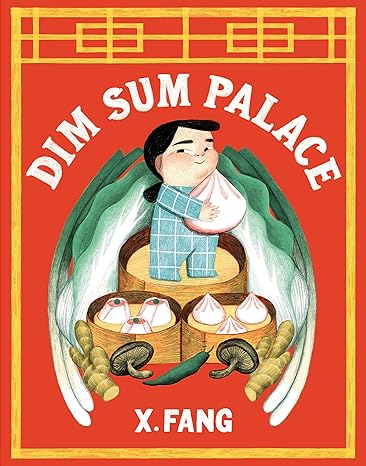
Dim Sum Palace, a debut picture book written and illustrated by X. Fang, majestically captures how our senses overpower even the most transcendent of dreams. I really fell in love with the juxtaposition of present vs past, real vs dreamed. The title instills a sense of wonder & captures the innocence of childhood, where we take things very literally (to this day I am still disappointed that there is no lake in Lake Jackson or pear trees abundant in Pearland). Fang brings these childish daydreams to life, magnificently.
Book Summary
Liddy is our protagonist. Liddy is actually excited to go to bed because she can’t wait to visit Dim Sum Palace the next day with her family! She can’t help but imagine that it will be a real palace. Shortly after going to bed, an enticing aroma wakes her up. She opens the door to her room and walks into a garden entrance to Dim Sum Palace, where she is as tiny (& adorably plump) as a dumpling.
Every palace has an empress, she thinks and wonders if this one does as well. For a few pages, Liddy forgets about any empress as she is greeted and distracted by a huge feast before her. The empress soon appears, as giant as the cooks, ready to devour Liddy. Liddy manages to shout she is a girl, not a dumpling & the Empress puts her down. Liddy then wakes up for a second time & makes the ride to the Dim Sum Palace parking lot.
Art Appreciation
Fang’s art & muted tones create a serene experience & bring out the incandescence in Liddy’s and the Empress’s faces. She portrays the dim sum foods as a spread meant for a king—or in this case, an empress— awakening curiosity for those outside the culture & appetite for those within. I also love how plump her characters are. This creates a mirror for little Southeastern and Eastern Asian girls to reflect themselves on, instead of the more angular & thin-faced beauty standards that dominate the culture.
Dim Sum History
I was surprised to learn that the dim sum eating experience is actually new, considering how ancient the Chinese world is. It became predominant only in the 19th century near Hong Kong after tea rooms replaced opium dens as the main attraction for silk road travelers & traders (Asian Society).
I notice that with a lot of Chinese picture books the focus seems to be on dim sum, mooncakes, & the Lunar New Year festival. This feels equivalent to Spanish books featuring a fiesta and piñata, I’m always a bit annoyed by that, ha ha.
While I felt bad that my Lunar New Year books are about the dim sum experience I’ll defend myself and say that they written by Taiwanese (Fang) & Chinese (Lam) authors (scroll below). People outside the culture also may never have heard of dim sum: these two titles are SOLID books in content & illustrations when it comes to the subject. But I will link to a couple of non dim sum books below.
For older-elementary through junior-high-school-aged readers, I recommend Grace Lin as an author and Mulan: Before the Sword specifically, if you want somewhere to start. Before the Sword is a fantastical tale that takes a deep dive into Chinese mythology. If you want more of a slice-of-life type of Chinese title, check out My Beijing by Nie Jun, a charming graphic novel featuring a charming protagonist.
Dim Sum, Here We Come!
Written and illustrated by Maple Lam
The protagonist in Maple Lam’s story knows exactly what she is going to grab from the dim sum cart! I love her self-awareness & excitement to gather with her extended family for dim sum on Sundays. Lam’s tale will make your mouth water & you’ll soon want to find the nearest dim sum restaurant in your town.
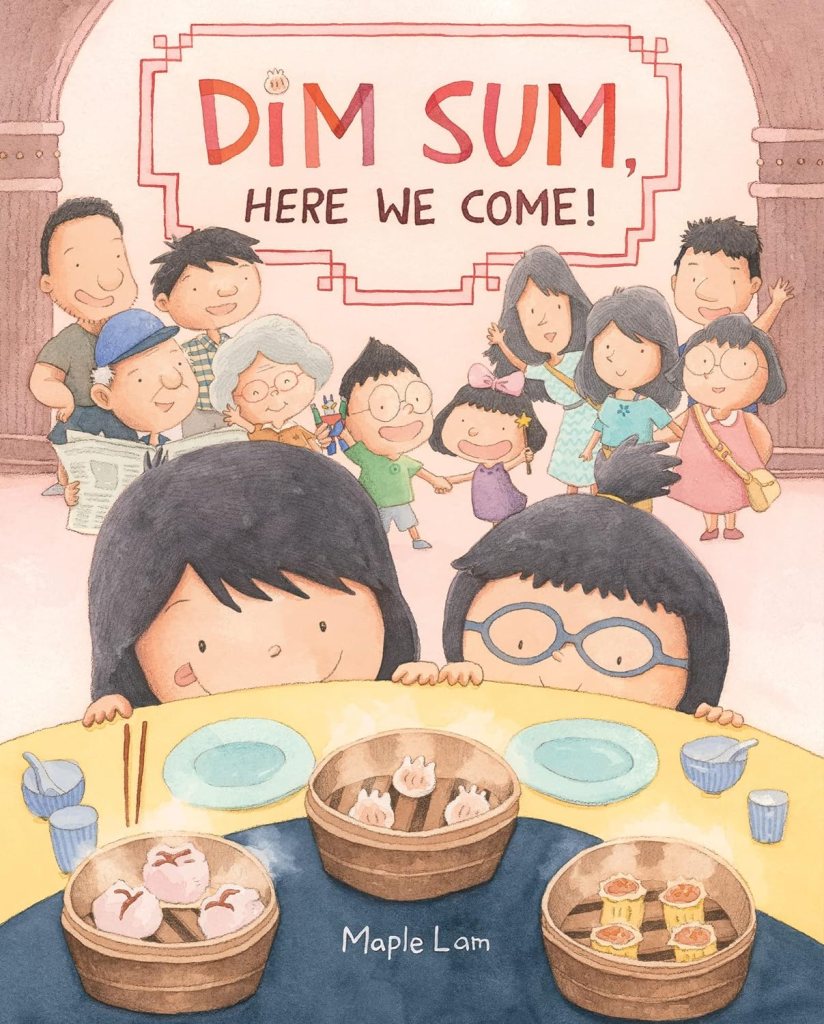
published January 2023
Lam explains the etiquette of dim sum without leaving those familiar with the experience wanting. She is precise with her dish names that it serves both as introduction & gives room to agree: “oh, that’s one of my favorites too!” To balance Fang’s grandiose tale, Lam demonstrates that places and food, no matter how humble, still offer a familial & cultural connection with those who dine in.
As evident in the cover, Lam’s illustrations do not get any less accurate within. I like the round faces & inclusion of glasses to show the diversity of the Southeaster and Eastern Asian features.
Traducción: La traducción será involucrada para el título de Lam pero accesible para el de Fang. Puedes usar ambos títulos para conversar sobre qué clase de experiencias similares hay en la cultura latina/Hispana a las del dim sum, las tapas españolas o brunch, por ejemplo. Abajo les dejo mis 5 traducciones:
- empress = emperatriz
- wafted = ráfaga
- wildest dreams = sueños más descabellados
- dumpling = no hay palabra en español, pero puedes quedarte con dumplings o empanaditas o hasta gorditas
- chef = french borrowed word, entonces en español se queda chef o puedes usar cocinero
Yo crecí comiendo los sábados en casa de mi abuela materna. Se sentaban los tíos, tías, abuelos, y bisabuela a almorzar siempre con un agua fresca, usualmente de limones del árbol del patio de ella. Ahora mis dos niños también esperan comer cuando visitamos a mi mamá los fines de semana 😅
What food traditions exist in your family?

 Biblioterika