
My son’s school library, in which I volunteer, had a title that caught my attention so I brought it home to read! Come to find out The Amazing and True Story of Tooth Mouse Pérez is a 2023 translation of a 2010 Spanish publication: La asombrosa y verdadera historia de un ratón llamado Pérez. The Spanish version is doubtlessly a treat compared to its English counterpart but I am glad that the U.S. has access to this marvelous story in English!
The Amazing and True Story of Tooth Mouse Pérez
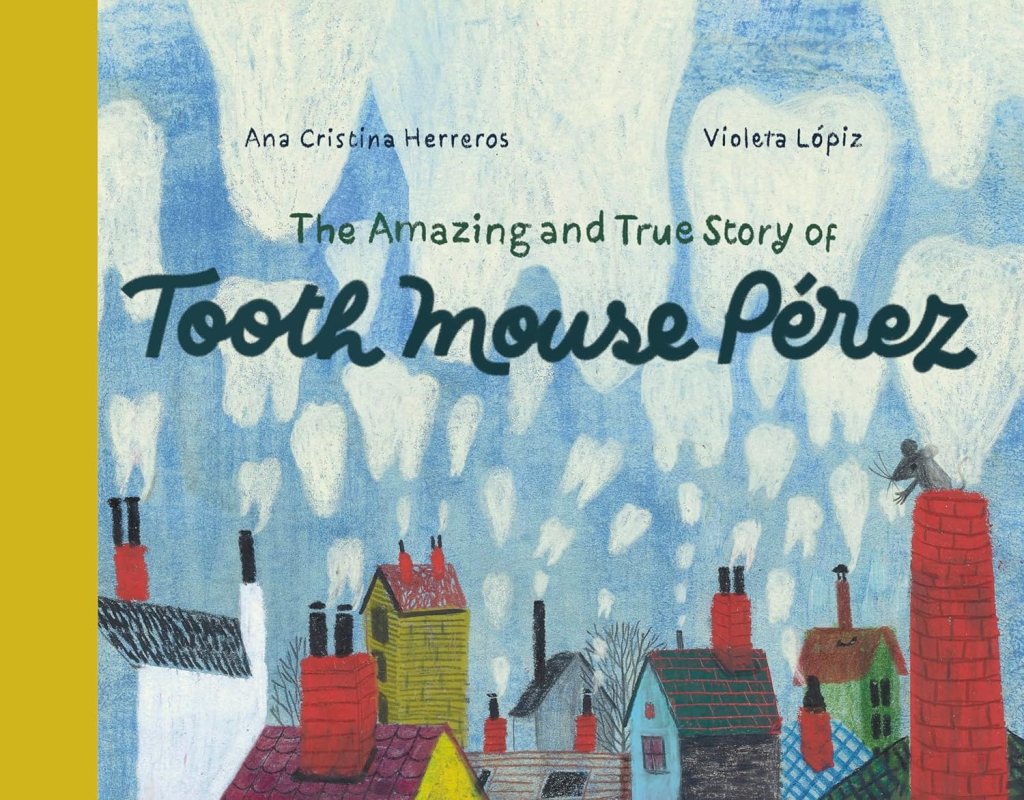
Writtten by Ana Cristina Herreros, illustrated by Violeta Lópiz. The tooth fairy does not visit our household when my children lose a tooth, el ratón pérez does! Growing up, nobody visited me haha, but seeing as my children love anything pretend and imaginary I have to sometimes compromise as to which mythical creatures show up at our house.
Honestly, I did not know the story behind el ratón pérez, I only know of him through cultural osmosis, things I had heard in Mexican tv shows, or once or twice heard a parent mention… Following the path of fractured folktales’s “true stories” like The True Story of the 3 Little Pigs!/ ¡La Verdadera Historia de los 3 Cerditos! or The Wolf’s Story Herreros makes her cuento read more like a documentary. She takes the tale seriously and reports credibly. This book is great to convice little ones of the magic & a perfect example for older, no-longer believing readers to practice their critical reading skills.
A hefty read, Herreros begins her tale with “a long, long time ago” which discerned readers will recognize as a synonymous phrase to “once upon a time” i.e. a fairy/fictional tale but netherless we give into the willing suspension of disbelief a few paragraphs into the story & take the story at face value.

The story of Tooth Mice begins in Spain, when people were already dwelling in houses, first thatched, then tiled. When Spanish children lost a tooth, they would run outside, turn their back to their home, & throw the lost tooth toward the roof if hopes that a Tooth Mouse would catch it! Back then the only wish was to get a stronger, permanent tooth. It is with the modern tooth mice that the whole affair became a transaction– tooth were given with expected coins or small gifts in return.
Herreros truly dives deep into this folktale, weaving other culture’s tooth creatures like an ant and the tooth fairy into the narrative, which is very smart from a marketing perspective, but also very thoughful & inclusive. I started reading the book with a bit of fear of crushing a make-belief but was soon reassured by the figurative text. She also says how it is the Tooth Mice took the Pérez last name instead of Villahermosa, or even the more common García.
Lópiz’s illustrations can be defined as vintage or timeless. The thickness of what appears to be oil pastels or crayons adds density to an already profound read. Lópiz delivers in bold, saturated colors imaginary scenes so we don’t have to guess at what things were actually like.
La asombrosa y verdadera historia de un ratón llamado Pérez

Me encantaría leer el cuento original en español ya que el lenguaje en la versión de ingles es avanzado y figurativo. Es una historia con mucha imaginación y cuidado por las creencias infantiles pero sin tratarlos como niños. El propio libro les recuerda que parte de perder los dientes es el hecho de que están creciendo, no solo en estatura si no en madurez.

 Biblioterika