BIBLIOGRAPHY
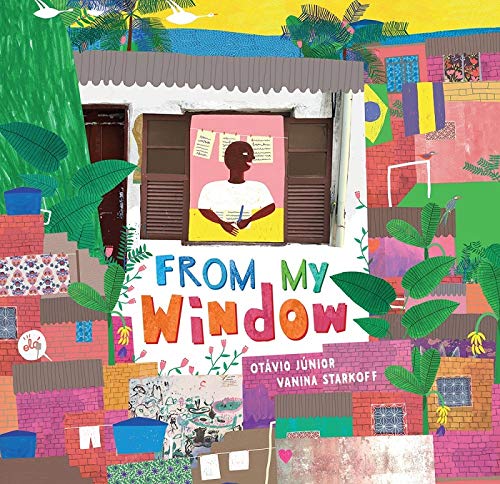
Júnior, Otávio. 2020. From My Window. Illustrated by Vanina Starkoff. Translated by Beatriz C. Dias. Cambridge: Barefoot Books. ISBN 978-1782859772
PLOT SUMMARY
In lyrical language, a boy describes what he sees from the window of his favela, a community governed Brazilian district that is vibrant with life. He describes the district at different times of day, its daily activities, the big dreams of its residents, as well as and the culture that rises from the shacks and “patched roofs” of the Complexo de Alamão favela.
CRITICAL ANALYSIS
Otávio Júnior adds his own voice to the ruckus of sensationalized news stories regarding favelas and presents a book about Brazil without mention of its Carnaval. From My Window establishes that there is more depth to living in a favela than crime.
Just like in real life, the bad is interspersed with the good in Júnior’s text and Starkoff’s colorful illustrations. Crime certainly affects the life of the boy, which is why he seems confined to his “shack.” It is implied that crime also shuts down the whole district midbook. However, this break in normalcy usually happens few and far between the macro-level day-to-day living of residents. Perhaps it is that crime is not that bad, or that people of the favela are resilient enough to live through the “sounds that make [them] sad.” The latter most definitely deserves praise, which Júnior delivers.
Conditions are rough in the favela, but there is an undeniable communal, creative, entrepreneur, and scholarly spirit that drives residents. Qualities, Júnior assures everyone, that ensure residents can not only survive, but succeed. Opposing the view that people would want to leave the favela, though the boy “wants to see the end of the rainbow,” he takes ownership of his favela, and descibes with heart his home. Neighbors, friends, and art root him to this place, and he is not resentful.
Starkoff, an Argentinean-born illustrator turned Brazilian resident, interprets Otávio Júnior’s words with cultural accuracy, authenticity, and a perfectly matched vision. She shows readers what a favela is before they ever learn the word: a word the duo know has negative connotations. The narrator is upfront about the poverty in his neighborhood from page one, and Starkoff’s opening spread, comparable to a quilt, is certainly one of a “patched” up neighborhood. The stacked, lopsided buildings, the laundry on lines, the twisted and exposed power lines and barred up windows are all evidence of impoverishment and disrepair. In contrast to the grays, browns, and darks associated with poverty however, from the first page, Starkoff paints buildings in optimism brights. All subsequent pages depict a vibrant, educated, and fine arts appreciative community. Enthusiastic “olá” talk bubbles are abundantly interspersed throughout. Although, readers cannot see the speakers, they invoke a welcoming human presence. Most of the cocoa-dark to guava-pink crowds have smiling or joyful expression.
Despite the grand buildup to introduce his favela, the narrator ends on a lighthearted tone, asking readers what they see from their window. Aside from incorporating a traditionally Western picture book element, this interactive question not only places the book in line with other mainstream children’s authors, but removes From My Window from being an explanatory text trying to prove the non-threatening nature of the favela, to one placing the favela in the same level as the reader’s neighborhood.
Children native to favelas will rejoice to see themselves represented in From My Window, while outsiders receive an honest but un-dramatized view of a favela. Otávio Júnior’s work is a conversation starter not only about the similarities between well-to-do neighborhoods and favelas, but also the true meaning of community as a collection of people willing to help each other thrive.
AWARDS
2021 Commended title in Americas Award for Children’s and Young Adult Literature
2021 Kids’ Book Choice Awards Nominee
2021 USBBY’S Outstanding International Books list
2021 Cybil Award Nominee
2021 Bank Street’s Best Children’s Book of the Year
2020 A Junior Library Guild Selection
REVIEW EXCERPTS
From Publishers Weekly, starred review: “Júnior, a writer who grew up in a favela in Rio de Janeiro, has created a loving tribute to his home….Digitized acrylic paintings by Starkoff are an artfully composed quilt of colors and activity; they combine the sweep of a grand mural with intimate, relatable moments of fun, joy, and resilience, and provide plenty for young readers to notice and appreciate.”
From the publisher, Barefoot Books: “From My Window is a picture book inspired by author Otavio Junior’s childhood growing up in a favela in Brazil…The vibrant, colorful illustrations add the perfect touch to this unforgettable, read-aloud picture book, highly recommended especially for public library children’s collections.”
CONNECTIONS
Show children what a favela looks like in real life, either my watching a kid friendly YouTube video or searching the library/school database for one. Then answer the question: how is life similar in the favela as in my neighborhood? Have children draw what they see from the window of their homes.
Read other books about Brazil:
-Vilela, Fernando. 2019. Along the Tapajós. Young readers can explore the Amazon in this award-winning ownvoice international title. ISBN 978-1542008686.
-Baby Professor. 2017. What Will I see in Brazil? Geography for Kids/Children’s Explore the World Books. Non-fiction title containing photographs. ISBN 978-1541915794.
-Hambrick, Monet. 2019. The Traveling Child Goes to Rio de Janeiro. ISBN: 978-1733008204. Parents may choose to follow the Hambrick Family on Instagram (@thetravelingchild), where they share trips and offers tips for travelling with a family to unconventional destinations.

 Biblioterika