BIBLIOGRAPHY
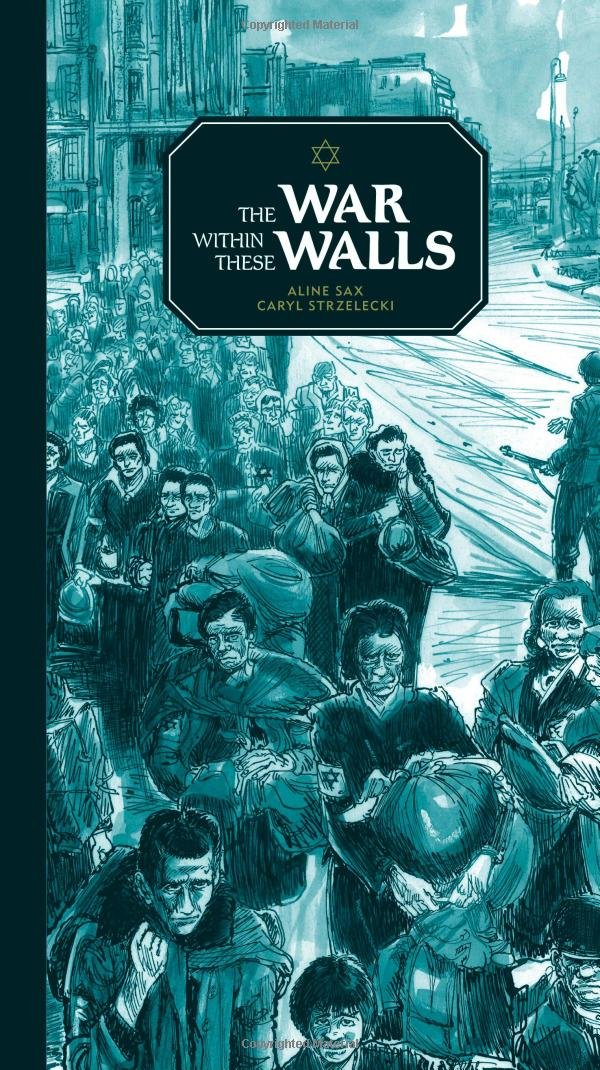
Sax, Aline. 2013. The War Within These Walls. Illustrated by Caryl Strzelecki. Translated by Laura Watkinson. Cambridge: Eerdmans Books for Young Readers. ISBN: 9780802854285
PLOT SUMMARY
A year or so after the German invasion of Poland, young-man Misha, his father, mother, and younger sister Janina watch as a wall is built around the Jewish district of Warsaw. Jewish from all over Poland are crammed into this ghetto and soon their home. People are starving and sickly, dying of malnutrition and poor sanitary conditions. Misha smuggles food from the Aryan side for his family until German guards discover and scorch to death another pair of child-smugglers. Traumatized, Misha is too afraid to sneak out again. Janina takes his place, until one night she does not return.
Conditions become bleaker three years after the ghetto is established. Posters alert residents of “resettlement.” After witnessing a soldier murder a baby and shooting a mother in cold blood, Misha realizes they are being hunted and murdered. Terror paralyzes Misha, until the commander of Jewish resistance in the Warsaw Ghetto, Mordechai Anielewicz, extends his hand, reminds him he is in fact still young and able, and encourages him to fight. Misha finds strength through purpose helping an underground network prepare for an uprising.
The night of the uprising, fighters know it is a battle for honor rather than victory. Jewish resistance takes German soldiers by surprise the first night. However, after weeks of hiding in underground bunkers, civilian murders, and the deaths of the commanding officers, including Mordechai, there is nothing left for Misha to do but flee the ghetto with a fellow comrade. Together they will ensure the fallen receive worldwide recognition for confronting an unrelenting enemy with valor.
CRITICAL ANALYSIS
The War Within These Walls succeeds in giving a name and a face to the countless victims that faced the brutality of the Nazi regime. Strzelecki’s stark black and white sketches match the dejected ghetto environment while masking the unimaginable horror victims experienced living through these images with their five senses.
Misha is an authentic character that reacts according to his surroundings. Upon having to wear a star of David, he is resentful for being Jewish. His father reminds him that they must face what comes rather than deny their identity. Used to religious persecution, this is why many rural Jewish accepy their fate and “shuffled their feet and looked at the ground” when they show up in Warsaw (p. 19). Despite being clumped together as “Jewish” by Germans, Misha does not experience some immediate brotherhood to newcomers. He resents their humility and their taking over his home. Despite suffering the hunger, sickness, and death together, Misha and many of the residents “never became neighbors” (p. 25). Instead, everyone avoids each other’s eyes, knowing they are forced to live in deplorable conditions, and ashamed that the Germans are reducing them to nothing.
Through Misha’s hopeful denial, readers are slowly walked through the realization that the Germans are annihilating the Jewish. Many concentration camp prisoners probably did believe work would eventually make them free. Despite the pangs of hunger, despite the carts hauling skeletal bodies to mass graves… victims were willing to hold on another day, hopeful for a what used to be or could be, rather than end their despondent lives.
As a Nazi prisoner, Misha suffers trauma. The manhole flame-thrower incident shocks Misha from continuing to smuggle food for the family. However, he recognizes that smuggling is against the rules, and that smugglers are punished for breaking these rules. It is not until Misha sees German soldiers murder the baby and mother in cold blood that he realizes there is no logic to the madness, and fear truly paralyzes him. Misha could have died after that moment, starved and stunned, trying to make sense of the incomprehensible. It takes Mordechai, a revolutionary with fire in his eyes and his soul, to snap Misha out of shock. No doubt Mordechai did breathe purpose and fire to “approximately 750” Warsaw youth (p. 171) in order that they could sustain a five-week uprising while starved.
The novel is historically accurate. Often referred to as “Nazi pigs,” Sax adds dimension to the enemy with the inclusion of the German spies, Jacob and Fromka. Earlier, Misha observes that “the Poles,” Aryan Warsaw residents, are likely sneaking food to the funeral cart men. When he sneaks out to scavenge for food, he finds a former friend’s father leaves his bakery purposely unlocked for Jewish smugglers. These are examples of quiet resistance, and the humanity of the “bad” side, even during war.
Misha’s story stands out from other WWII literature. Sax’s narrative opens with death and culminates in battle. Sax is as unapologetic and direct describing the conditions of the Warsaw ghetto as German bullets were in hitting their victims. Sax seeks not to commemorate the lambs of the war, but the “wolves.” The Polish and Jewish flags are mentioned in the text, and included by Strzelecki in the graphics. Genocide is discrimination and hatred against an ethnic group, but also a political tactic to unify the majority against a dehumanized “other.” Jewish fighters were proud to be Jewish AND Polish. Despite their Polish neighbors turning their back on them, they were still fighting for both their ethnic and political identity.
The War Within These Walls invites reflection not only of what transpired, but how easily it could happen again. The dehumanization of neighbors for political gains has happened and is happening across the globe since the Warsaw Ghetto Uprising. Did Mordechai and his fighters die in vain? It is up to readers and citizens to ensure they did not.
AWARDS
2015 Storytelling World Resource Award
2014 Mildred L. Batchelder Award, Honor Book
2014 Parents’ Choice Award
2014 Silver Medal, Historical Fiction
2014 Sydney Taylor Book Award
2014 USBBY Outstanding International Books List for grade 9-12
2014 Sydney Taylor Books Award, Honor
2013 Cybils Awards, Nominee, Young Adult Fiction
2013 Winner of the National Jewish Book Award
CONNECTIONS
Visit the United States Holocaust Memorial Museum Website, as suggested in the historical note. The pages on Warsaw are most relevant:
–Demographics of the city
–The Warsaw Ghetto Uprising
Visit the USHMM YouTube Channel, to find Warsaw related content, such as “The First Person” conversation series. This one features Estelle Laughlin, a Warsaw Ghetto resident.
Activities: Have students discuss in groups or write individual essays about why it was so difficult for the Jewish to escape their fate? What can we do as citizens to ensure we do not fall into the trap of dehumanizing our neighbors?
Read available biographies on Mordechai Anielewicz on Biography databases, or read the elementary level ones available:
–Hausfater, Rachel. 2022. No to Despair: Mordechai Anielewicz. 10 years and up. ISBN: 978-1644211328.
–Callahan, Kerry P. 2001. Mordechai Anielewicz: Hero of the Warsaw Ghetto Uprising. ISBN: 978-0823933778.

 Biblioterika